Welcome to our family blog!

We began in September 2010 by traveling a portion of the Camino de Santiago, the ancient pilgrimage route that leads to the tomb of Saint James in Santiago, Galicia, in the northwestern corner of Spain. The name of our blog is inspired by the camino, and we'll have many stories (cuentos) to tell! We spent 2010-2011 on an intentional international journey, living and working in Spanish-speaking countries. Since then, we are immersed back in our lives at home but will report on occasional openings and discoveries. Please join us!

Tuesday, November 30, 2010

finches at Casa Encendida, Madrid


The most interesting artwork I saw today was a roomful of colorful finches. There were grasses and nesting areas set up for them. There were also several electric guitars and cymbals set up at the right height for them to perch on. When they did, they effectively played music on them. Random music for sure, but with a certain grace reflecting their finch-like ways. Hopping up and down  the neck of the guitar, dropping bits of hay on the strings, etc. One little bird fell asleep on one of the guitars, resting its beak among its feathers.  They were not shy, and we could watch them from very close by.
What was most lovely to me was the way people who entered became part of the artwork. People tended to slow down and wander around quietly, and sometimes to share glances in a bemused way.
Unfortunately photos were discouraged. But I am inserting several photos from our last few days in Madrid, as autumn turned to winter.

Quaker Meeting in Madrid


Holiday lights

Lucifer statue in Retiro Park

Snow in Madrid November 29

Ham for sale

Saturday, November 27, 2010

Where have Laura and Conor gone?

All this week and the last, Laura and Conor have been busy researching and writing on their chosen topics. Laura will place Picasso's Guernica in Spanish history and the art world. Conor will detail the Moorish contributions to modern Spain and Europe. Perhaps they will choose to publish their papers here!

Thoughts on words and other themes

Upon listening to a lecture on engineering in the third world: Three solid hours of listening hard, trying to understand the scientists’ university lecture. Sometimes I repeat the words silently, let them roll around in my mouth, hoping that their hard shells will give way to reveal the soft sweetness of understanding within. The Spanish words are like flamenco singing, strong consonants like castanets, alternating with guttural soft “g”s where you do not expect them. Sometimes the speech goes too fast to hold onto a single word, and my mind skims over the cold hard stones. They escape my grasp, and I cannot crack open any of them. Tired, I let them slide by.
Signs: English-language signs are in fashion, lending a sense of the latest style to the goods being sold. We English speakers snicker at the way that foreigners put words together. Instead of “Dunkin’ Donuts”, the name of the chain is altered here to “Dunkin’ Coffee”. What is being dunked? A nearby cafeteria is called “Flunch”, altering the word “lunch” with a zesty “f”. Doesn’t it make you want to try the food? I love the sign on a store “So JHappy!”, reminding Spaniards that in English the “h” is not silent.  
When we’re done snickering, we go back to trying to understand the fluent Spanish all around us. When you trip over verb tenses and can’t find basic vocabulary words, it’s hard to remember that you’re a capable adult!
Thanksgiving: It is of course a day like any other here. We decided to move it to the weekend so that our hosts could join us in a meal. We looked high and low for cranberries without success. We did find a turkey, and chestnuts and wonderful ice creams. Calabaza (squash) will substitute for pumpkin, though we did hear that the large orange variety we call pumpkins are sometimes available. We’ll be making stuffing by hand, which will do us good. And apple pie can be made everywhere!
Weather: Yesterday was the first frost. Almost a month later than at home, where we usually can count on a frost by Halloween. I went for my morning run and the grass was crispy and white. We do not have our winter coats, so each daily drop in the temperature is greeted by a sense of foreboding. Not wanting to carry extra clothes with us to warm Kenya next week, we tough it out with sweaters and the old standby, layering. I tell the kids that it doesn’t matter what we wear here. Shirts under shirts and socks over socks – who cares?
Flamenco: It is Spanish to the core. A mix of Moorish music in the minor key, red and black and drama for Spain and its bloody history, and gypsy mystery, from the Roma people who originated in India many centuries ago. Many of the songs voice the same familiar laments as cowboy tunes, the words just as cheesy. But still they give me goose bumps. A people (or peoples, since flamenco was born in the gypsy/Jewish ghettoes of Spain) oppressed, singing about the tragedy and injustice of life. The songs give voice to the deepest sadness in the world.
What I see in the marvelous dancing is a pride, a regal bearing. The woman tosses her scarf over her shoulder and gives the man a haughty look. The insistent tap dancing moves call attention to the strength and pride of the dancers. Yet the people who created this music originally lived in caves in Granada, in the Sacramonte hills, where they worked as potters and rag sellers. Metalworking was the most elevated profession, one to aspire to. The holy spot for flamenco today is a warehouse in the urban Roma ghetto outside Sevilla, the Poligono Sur. Flamenco today is mixed with drugs and violence, yet flamenco dancers have an incredible mystique. To be a flamenco star is to be a hero in Spain.

Friday, November 19, 2010

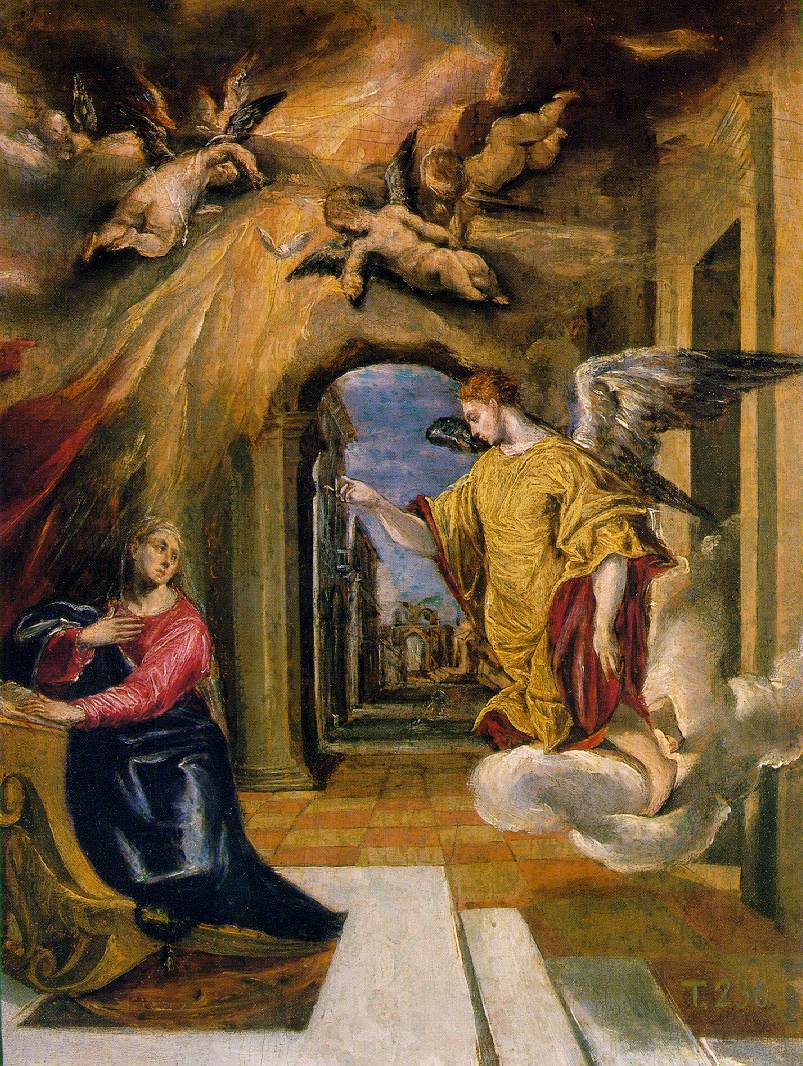
The Annunciation - Conor

The Annunciation
While visiting the Thyssen Bornemisza Museum in Madrid, one painting in particular stood out for me. I had seen a lot of religious paintings from the 15-16th century, with Flemish and Italian painters. When I saw the Annunciation by El Greco, nicknamed the Greek for his long and cumbersome actual name, I was surprised by the fluidity and freedom of his lines. Although this subject was portrayed with a more Gothic style, El Greco’s take on the scene was refreshing. Here is the picture:

At the Art Museum - Laura

At the Art Museum
               
A bright pink flower and a bright pink bird, splashing color onto the stormy mountains. Bird and flower sing fragile, handle-with-care songs, but those water balloon clouds don’t seem to be listening.  Helpless, they wait for the clouds to pop and the wind to roar and gobble them up. So small, so beautiful, so colorful, they wait.
                A child watches the sea. It rolls; a fascinating jumble of green and blue and purple, and bubbly white at the edges.  The bubbles reach their fingers out to her, pleading her to throw off her shoes and let the cold climb up her feet.  Laughing shrieks from barefoot children tug at her legs, willing her to come in and play. But she tells them not now, because right now she is very busy. Right now, she’s tying the sand and the sea and the sky into one big bow on the back of her dress.
                 Gray shards of reality mash together.  Somewhere, an orange slice moon washes the world in blue strokes of light. Sometimes, a hand flies over an instrument’s neck, bathing the world in music. Or maybe the moon plays the music and the hand paints the light, and all around them, reality bends lines into geometric shapes. Where and when are thrown away, here is there, and now is never. Time has gotten confused and is running circles around a musician, who plays lonely songs under the moonlight.
                                How still everything is. Not a leaf flutters or a wave crashes. Even light stops moving.  Everything is caught mid-thought, mid-storm, mid-song, all stopped by a paintbrush. Each painting is a world on pause, and I’m free to explore every detail, until I could slip into the canvas. Until I could jump in next to the bird and the flower and feel dizzy because we’re right on the edge of the mountain and the ground is so far away.  And when I leave the museum, my whole world is moving a little slower, and it seems like everything is just waiting to be painted.

Remembered Moments

In no particular order, below are some remembered moments from our recent travels.
Archeological Museum, Madrid - La Dama de Elche sits tall and monumental, life size, despite the fact that she is 2500 years old. She gazes straight ahead, her dark hair pulled up in combs in a style adopted much later by residents of the south of Spain. She is the first Sevillian woman, two millennia ahead of her time. With her beautiful mantilla (scarf), her dark hair and strong nose, she could have stepped out of last year’s photograph of the traditional Holy Week celebration. In fact, she is a burial urn, containing her own ashes. I can tell from the work that she was loved and revered, a holy woman from ancient Iberia.
I was struck by another pre-historic piece, the small statue of a woman whose body is a goblet. The drink is poured in at the top of her head and comes out in a wide bowl that she carries, breast height. The effect is of her breasts offering drink to the hungry traveler. How innocent and unguarded, the desire to return to mother’s milk as refreshment!

Roman chariot racecourse, Tarragona

Tarragona Chariot Races – (a historical vignette) See how the chariots burst out of the tunnel and around the corner! Who will be first? Will I win my bet? One horse is bloodied – it must have grazed the side of the tunnel as it rushed along. The tunnel is barely wide enough for one chariot pulled by a team of four horses. Overtaking might well lead to injury or even death for a horse or rider.  Standing with my family in the amphitheater, I am surrounded by summer’s heat, amplified by the spectators and the dust thrown up by the winning chariot as he takes a victory lap around the stadium.
The Alhambra in Granada, as understood by a modern photographer - “Granada es Oriente y Occidente. Hasta ahí se extienden las piedras germánicas para encontrarse con el Islam. Las columnas del Palacio de Carlos V con las fuentes del Palacio de la Agua de la Alhambra. Granada es el producto de dos ríos de sangre y de dos culturas en un encuentro vivo.”  Translated: “Granada is East and West. Down to here extend the Germanic rocks to encounter with Islam. The columns of the Palace of Charles V with the fountains of the Water Palace of the Alhambra. Granada is the product of two rivers of blood and of two cultures in a living encounter.” This is a statement by Jose Val del Omar, a Spanish photographer who has produced a film project being shown in the Reina Sophia Museum in Madrid. It is an impressionistic piece with water flowing, children laughing and fish swimming. It feels like a dream.

Court of Myrtles, Alhambra

Granada is indeed a “mix of Eastern and Western culture”. It contains those “Germanic rocks”, the palace that King Charles V of Spain built after his takeover of the Alhambra fortress. The Spaniards were impressed by the Alhambra, built in the 11th century by the Moors, and amazingly did not destroy it completely when they took over in the 15th century. As a result, the languid pools are still full of fish, the Arab arches rise over the quiet patios and terraces, and the “fountains of the Water Palace” still flow with cool water. As to the people who created these wonders, they were oppressed, made to convert to Christianity, killed if their conversion did not seem genuine and eventually expelled to Morocco where they swelled the size of cities such as Fez.
Granada is not just the calm and beautiful, but the violent and bloody. The shield held by Boabdil in his final encounter, trying to defend the Alhambra before losing it, his last toehold on the Spanish peninsula, is preserved in the Royal Palace in Madrid. “Granada is the product of two rivers of blood and two cultures in a living encounter”. The same could be said of Spain as a whole. So much of Spanish culture came from this encounter, this mixture of East and West.
The Mezquita in Cordoba Even more so than the Alhambra, the Mezquita (or mosque) in Cordoba is a mixture of Moorish and Catholic culture. Moorish civilization is said to have reached its acme in Cordoba, home to scientists, mathematicians, and philosophers from the 10th through the 15th centuries. The production of paper was brought to Europe here, as was algebra, astronomy and astrology. Christopher Columbus consulted with Moorish scientific advisors before starting on his trip to the “Indies”.

Cathedral in the Mezquita, Cordoba

Synagogue, Cordoba

 Contrary to the tourist brochure newly published by the Catholic authorities, it is clear that the Moors who built the Mezquita in the 10th century respected and preserved the antique Christian Visigothic Church underneath.  Instead of erasing the past, they preserved it; remnants can be seen today in the sculptures inside the mosque. After the Reconquista of Spain by Christians, an entire cathedral was built in the center of the Mezquita. Surprisingly, the Christians did not destroy those old walls either. The forest of red and white sandstone columns built by the Moors is still the main event at the Mezquita. Horizontal, like an enormous forest, the Mesquita allows us to feel surrounded by the divine, not overwhelmed by vertical grandeur pulling us heavenward. Catholic chapels around the edge do not change this perception. The entire building seems a wonderful melding of Christian and Islamic, different faiths interwoven through time. A small synagogue with Moslem calligraphy on its walls nearby in the Jewish quarter adds to the understanding of Cordoba as the very center of Moorish civilization in its day, a tolerant community that welcomed scientists and worshipers from throughout the known world.  
House of the Indies, Seville – This building was originally built by Queen Isabella to house the riches brought back from the Americas to Spain. When we visited, there was a wonderful display on piracy. It led me to think more deeply about my own elementary school education. Though I had learned that Sir Francis Drake was the first to circumnavigate the globe, and that Sir Walter Raleigh was the first to set up an English colony in America, I learned in Seville that they were both scoundrels of the first degree, pirates and corsairs. Hawkins, Captain Cook, all those British adventurers were in fact bent on taking away land that had been rightfully claimed by Spain. Finder’s keepers? What is the difference between an explorer and a pirate?
The Spanish functionary is not dead – We have seen some incredible government inefficiency in Spain. The Prado is free from 6-8 pm every night. So at 6 there is a long line to the ticket office, where people must go to pick up their free ticket. Then, you must walk clear around the museum to the other door where you are allowed in. Though it might be sufficient to do away with the ticket altogether and have one person with a “clicker” at the door, this would eliminate any number of jobs.

My package

The post office is something out of Kafka. When you arrive you take a ticket depending on what you want to do: pick up a package, send a package, or buy an envelope to send something. Do you see a problem already? Then you wait anywhere from 20-40 minutes for your number to come up. When you get to the window, there is no rush at all to do your business. I had a friendly post office clerk help me to send a package to Morocco. He confided in me that though it would be easier to use a postal stamp, he is required to use so many stamps a day, and if he does not, he must buy them personally. So he decorated my package himself. There was no sponge for wetting down those stamps, nor was there a tape dispenser. He had to use his tongue and teeth a lot! Here is a picture of my decorated package.   
A Moroccan street - As I struggle to park the car within centimeters of the wall to avoid being hit on the street side, an old woman approaches the car, asking for alms. She is well dressed and carries a basket. “La, la”, I mutter, “No, no”. I am rushing and I do not normally give money to individuals. In the states, I contribute to organizations that serve the poor, rather than to individuals who might choose to spend the money on drink or drugs. How could I miss the fact that this was different? The woman gave me a look which indicated she was not used to being turned down, particularly on a Friday. Her look needed no translation: “You are going straight to hell, young lady!” It might have been helpful to have used the Arabic phrase, “May Allah help you”.
Traveling around Madrid - We are having fun with language. Here is a store whose owners wanted to ensure that Madrilenos pronounced "happy" correctly. So they added the "j" to help them remember not to use the silent "h"! An apt description for us!




Thursday, November 18, 2010

Photos

I figured out how to post pictures on the blog. I put them up on Picasa web albums and then shared them with the blog. So if you are interested in seeing more of the pictures, click on one of the two albums I just put up. If you want to see a caption, click on any individual picture then on the right side choose "edit". The caption and other info will ppear on the right. Then you can scroll through.

Let me know if this works!